
“I will bring my parents to the center, sister. You do not need to come to our home.” The young man was resolute, but respectful. Goldie, Back2Back India Site Director, nodded, making a mental note to follow up.
Back2Back staff met D* over a year ago while checking on families who call the slum community home. They noticed a young boy in the street who should have been in school, but wasn’t.
His story was not unusual, and that’s precisely why it was so urgent.
D was born to an older father, too weak to work, and a mother who was deaf and mute. His community was comprised of hardworking rag pickers – men and women who sorted through garbage to collect scraps they could sell for income. When his parents could no longer work, and he was old enough to help, D chose family sustenance over education.
This is the quiet distress many working-class families in India face: children stepping into adult responsibility long before they should, trading classrooms for survival.
Staff knew there was another path that wouldn’t force a choice between education and survival. D and his parents were invited into the Strong Families program. He was enrolled in an English-medium school, and his parents gained access to support and resources to strengthen their home. After eight months, D progressed into the Hope Program, pursuing higher education with renewed focus.
“He is doing remarkably in school,” Goldie shared. “He is an exceptional student and hardworking, even without his parents’ ability to assist him academically.”
As part of the program, staff regularly visited families to ensure stability and continued growth. From the beginning, D resisted home visits. He preferred bringing his parents to the center instead. With time, Goldie understood why.
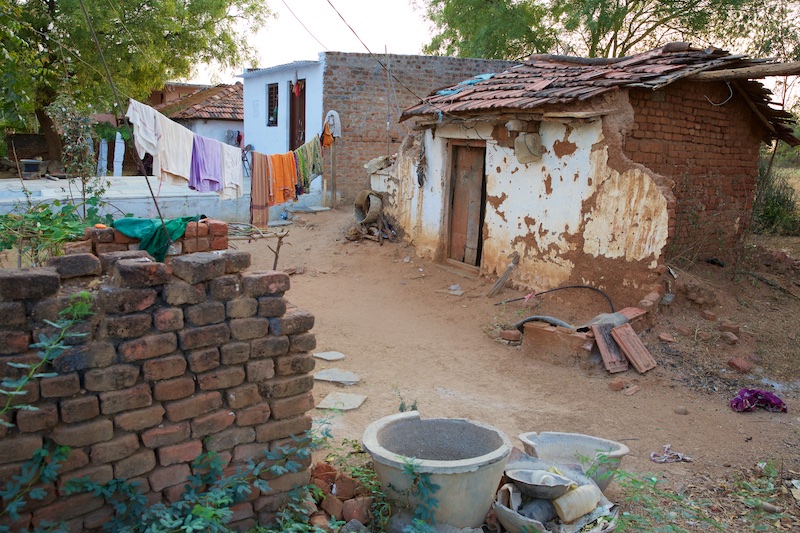
“There was no flooring,” Goldie recalled. “The roof was beginning to collapse. Pests had overtaken parts of the living space.”
Inside their fragile walls, dignity was still fiercely guarded.
During the visit, Goldie held up a photo of D in his classroom, seated at a desk, smiling, learning. She watched as his mother studied the image. She saw her son as the child he truly was. Tears streamed down her face; no translation was needed.
The family’s living conditions were addressed, and their community responded. The roof was repaired. Safe flooring and sleeping spaces were created. D stood nearby, stunned as neighbors stepped in to assist.
When the work was complete, the family expressed their gratitude in a traditional gesture of respect, touching the feet of those who had helped them.
But something deeper had shifted.
When D watched neighbors repair his roof, something changed within. It was more than relief, it was belonging. He saw living proof his family was worth showing up for.
Without that intervention, he would likely have remained out of school, carrying adulthood on shoulders meant for textbooks, his future narrowing quietly year by year.
Instead, he carried hope.
This is the difference intervention makes – not charity, but restoration.
And more children are standing at that same fragile edge, one crisis from leaving school, one illness away from stepping into labor too soon. Distress like this is rarely loud. It doesn’t announce itself.
But it doesn’t have to be the final word.
The question is not whether need exists. The question is who will step toward it.
Will you join us?